Yoga Styles
Hatha Yoga vs Vinyasa Yoga: Understanding the Difference
Slow and steady or flowing and dynamic? Learn how Hatha and Vinyasa yoga differ in pace, breath, intensity and benefits, which style suits you best, and why good yoga teacher trainings teach both.
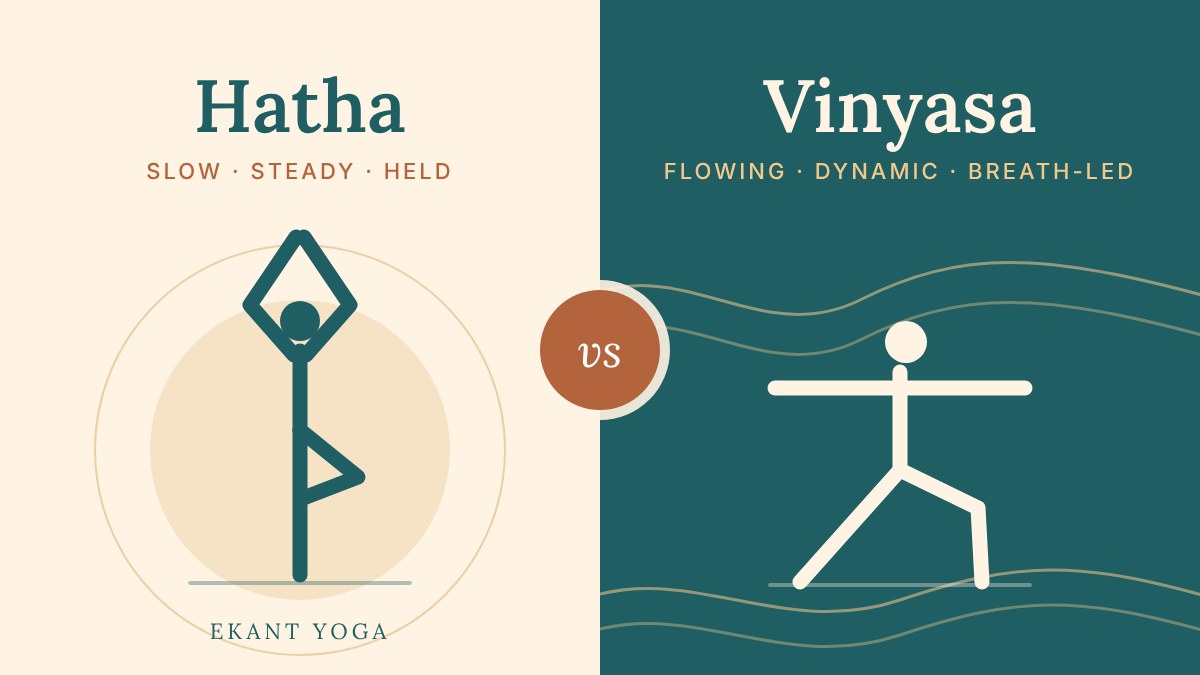
Look at almost any yoga studio timetable and you will see two names again and again: Hatha and Vinyasa. Both use many of the same poses, both work with the breath, and both come from the same ancient tradition. Yet a Hatha class and a Vinyasa class can feel completely different.
This guide explains what each style really is, how they differ in pace, breath and intensity, what a typical class feels like, and how to decide which one suits your body, your goals and your stage of practice. If you are thinking about becoming a teacher, we also explain why the best trainings teach both.
Key takeaways
- Hatha yoga is slower: poses are held for several breaths with time to focus on alignment.
- Vinyasa yoga is flowing: you move from pose to pose, linking each movement to an inhale or exhale.
- Hatha is usually the easier place to start; Vinyasa builds more heat, stamina and rhythm.
- Neither style is “better”. The right choice depends on your goals, energy and experience.
- A well-rounded yoga teacher training teaches both, so you can guide any kind of student.
The quick answer
The main difference between Hatha and Vinyasa yoga is pace. In Hatha yoga you come into a pose, stay there for several breaths, then rest before the next one. In Vinyasa yoga you move continuously from one pose into the next, with each movement guided by the breath, so the class feels like a flowing sequence rather than a series of separate postures.
Everything else follows from that: Hatha gives you more time to explore alignment and stillness, while Vinyasa builds more heat, strength and cardiovascular effort. Both are complete, traditional ways to practise yoga.
What is Hatha yoga?
Hatha is one of the oldest names in yoga. Classical texts such as the Hatha Yoga Pradipika, written by Svatmarama around the 15th century, describe Hatha yoga as a complete physical and energetic practice: postures (asana), breathing techniques (pranayama), cleansing practices, and concentration, all preparing the body and mind for meditation.
The word is often explained in two ways. Literally, hatha means “forceful” or “determined effort”. Symbolically, it is read as ha (sun) and tha (moon), the balancing of active and calming energies in the body.
Strictly speaking, almost every physical style of yoga practised today grows out of Hatha yoga, including Vinyasa. But when a studio or retreat lists a “Hatha class”, it usually means a slower, more traditional class where:
- poses are held for several breaths, sometimes a minute or more
- there is a short rest or a moment of stillness between poses
- the teacher gives detailed alignment cues and modifications
- pranayama and relaxation are an important part of the class
- the class often ends with a longer savasana or guided relaxation
What is Vinyasa yoga?
The Sanskrit word vinyasa is usually translated as “to place in a special way”. In yoga it describes the deliberate linking of movement and breath: you inhale to lengthen or lift, and exhale to fold, twist or lower.
Modern Vinyasa yoga grew largely out of the Ashtanga Vinyasa tradition taught by K. Pattabhi Jois, a student of the influential teacher T. Krishnamacharya. Ashtanga follows a fixed series of poses; Vinyasa keeps the breath-led flow but lets the teacher create a different sequence for each class. That is why Vinyasa is sometimes called “flow yoga”.
In a typical Vinyasa class you can expect:
- continuous movement, often built around Sun Salutations (Surya Namaskar)
- one breath per movement, often using a steady, audible ujjayi breath
- short transitions between poses, such as plank, chaturanga and downward dog
- a gradual build-up of heat and intensity, then a cool-down
- creative sequences that change from class to class
Hatha vs Vinyasa: side-by-side comparison
What does each class actually feel like?
A Hatha class
You might begin seated with a few minutes of breath awareness, warm up gently, then move through standing poses, balances, forward bends, twists and backbends, staying in each one long enough to adjust and settle. Pranayama and a long relaxation close the class. You leave calm, grounded and stretched.
A Vinyasa class
You might start with a few rounds of Sun Salutations to warm up, then flow through sequences of standing poses and balances that build in intensity, before slowing down with seated stretches and a short savasana. You leave warm, energised and often a little sweaty.
One common surprise: Hatha is not automatically “easy”. Holding warrior, chair or plank pose for ten slow breaths can be very demanding. Vinyasa feels harder on the heart and lungs; Hatha can feel harder on the muscles and the mind.
Benefits of Hatha and Vinyasa yoga
Both styles improve flexibility, strength, balance and body awareness, and both help to calm the nervous system. Their emphasis is a little different:
Hatha benefits
Builds a strong understanding of alignment, improves posture and stability, develops patience and concentration, and gives plenty of time for breathwork and relaxation. Well suited to stress relief and to anyone returning to exercise.
Vinyasa benefits
Builds heat, stamina and muscular endurance, raises the heart rate, improves coordination and fluid movement, and can feel like a moving meditation as breath and body fall into rhythm.
If you have an injury, a medical condition or are pregnant, speak to your doctor before starting a new practice and always tell your teacher before class, whichever style you choose.
Which is better for beginners: Hatha or Vinyasa?
For most beginners, Hatha is the better place to start. The slower pace gives you time to learn the names and shapes of the poses, understand how to align your body safely and get used to breathing calmly while you work. Those foundations make every other style easier later.
That said, beginners can enjoy Vinyasa too, especially if you are already active or find stillness frustrating. Look for a class labelled “beginner”, “slow flow” or “Vinyasa basics”, stay at the back, and take child’s pose whenever you need to. A good teacher will offer simpler options for every transition.
How to choose the right style for you
- Choose Hatha if you are new to yoga, want to learn correct alignment or prefer a calm, steady pace.
- Choose Hatha if your main goal is stress relief, better sleep, flexibility or gentle strength.
- Choose Vinyasa if you enjoy movement, music and rhythm and want a practice that feels like a workout.
- Choose Vinyasa if you want to build stamina and already know the basic poses.
- Try both if you want a balanced practice: Vinyasa on energetic days, Hatha when you need to slow down.
- If you dream of teaching, learn both, because your future students will be all kinds of people.
Hatha and Vinyasa in yoga teacher training
Many students choose a yoga teacher training because they love one style. The best trainings, however, teach both. Hatha gives you the foundation: how each pose is built, how to align and adapt it for different bodies, and how to use the breath. Vinyasa then teaches you how to connect poses safely, sequence a class with a clear rise and fall, and cue movement to breath.
Learning both makes you a more confident and more employable teacher. You can lead a gentle morning class for beginners, an energetic flow for regular students, or a mixed class that blends the two.
At Ekant Yoga, our Yoga Alliance registered courses in Galle, Sri Lanka and Goa, India include daily practice and teaching methodology in both Hatha and Vinyasa, alongside pranayama, meditation, philosophy and anatomy. Choose the 200 hour yoga teacher training in Sri Lanka or the 200 hour yoga teacher training in Goa, or start with a shorter course such as the 100 hour course in Sri Lanka or the 50 hour course in Sri Lanka.
New to teacher training? Read What Is a 200 Hour Yoga Teacher Training? or our guide to the best yoga teacher training in Sri Lanka.
Final thoughts
Hatha and Vinyasa are two branches of the same tree. Hatha teaches you to slow down, build each pose with care and find stillness. Vinyasa teaches you to move with rhythm and let the breath lead. Neither is better: the right style is the one that meets you where you are today, and many students end up loving both.
If you would like to deepen your practice or learn to teach both styles, contact us and we will help you choose the right course.
Frequently asked questions
What is the main difference between Hatha and Vinyasa yoga?
Pace. Hatha holds each pose for several breaths with rest in between, while Vinyasa flows continuously from pose to pose, linking each movement to the breath.
Is Hatha or Vinyasa better for beginners?
Hatha is usually easier for beginners because the slower pace gives time to learn alignment and breathing. Beginner-friendly Vinyasa classes are also a good option if you are already active.
Is Vinyasa harder than Hatha?
Vinyasa is usually more physically intense because you keep moving, but holding poses in Hatha can also be challenging. Both can be adapted to any level.
Can I practise both Hatha and Vinyasa?
Yes. Many people combine them, using Vinyasa for energy and fitness and Hatha for alignment, recovery and relaxation.
Is Vinyasa the same as Ashtanga?
No. Vinyasa grew out of Ashtanga Vinyasa yoga, but Ashtanga follows a fixed series of poses, while Vinyasa sequences change from class to class.
Does Ekant Yoga teach Hatha and Vinyasa in its teacher training?
Yes. Our Yoga Alliance registered courses in Sri Lanka and Goa include both Hatha and Vinyasa practice and teaching methodology.